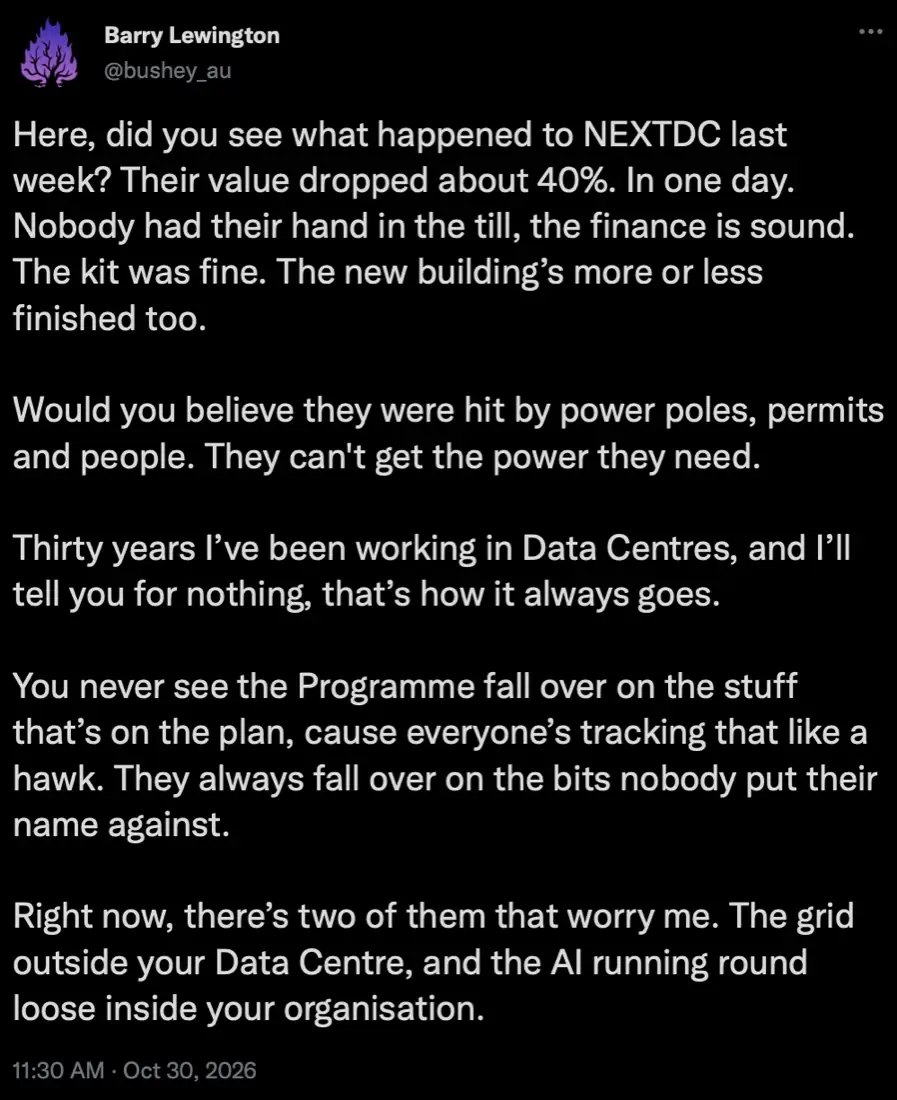
Last week, NextDC, Australia’s largest listed Data Centre developer, saw its shares fall around 40% in one day. That was its worst day since listing in 2010, and roughly $3 billion of market value was gone before lunch.
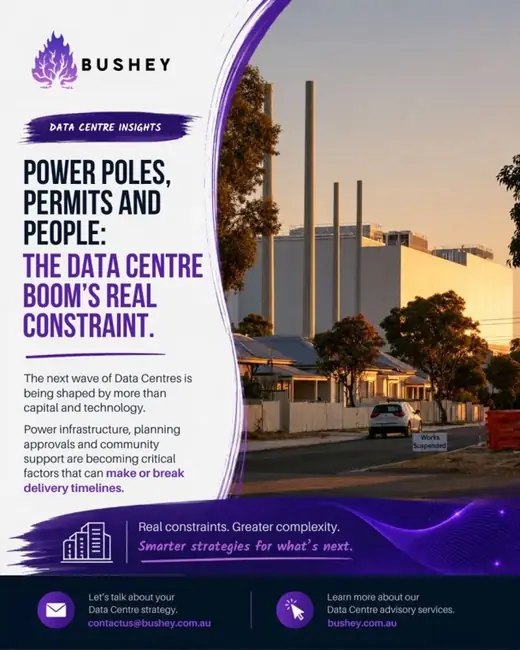
The cause was its new M3 facility in Melbourne’s west. Construction was going well and the contracts were signed. What stalled was the power. Jemena’s upgrade of the local network, which meant replacing poles in Yarraville and West Footscray with concrete poles up to 22 metres tall, was suspended after residents objected and council withheld consent. Work isn’t expected to restart before February 2027, and NextDC has cut its FY27 earnings guidance by more than a third.
It isn’t a one-off. Goodman walked away from a $1.2 billion Sydney Data Centre in September after opposition from residents and policymakers. In the US, more than a hundred projects have reportedly been blocked or delayed this year.
3 things to take away
- Capital is no longer the constraint. The hardest dependencies now sit outside the finance team: grid connections, planning approvals and the people affected by them.
- Communities are stakeholders, not a permitting step. No major transformation would roll out without a change management plan, yet the people a programme depends on are often treated as an obstacle.
- This is a national issue. Australia needs investment in critical infrastructure and dedicated technology parks, with power, water and telecoms already in place and away from homes, so the sector can grow without these fights.
These things don’t sit neatly on a Gantt chart, yet they decide whether your programme lands on time.Read the full article