
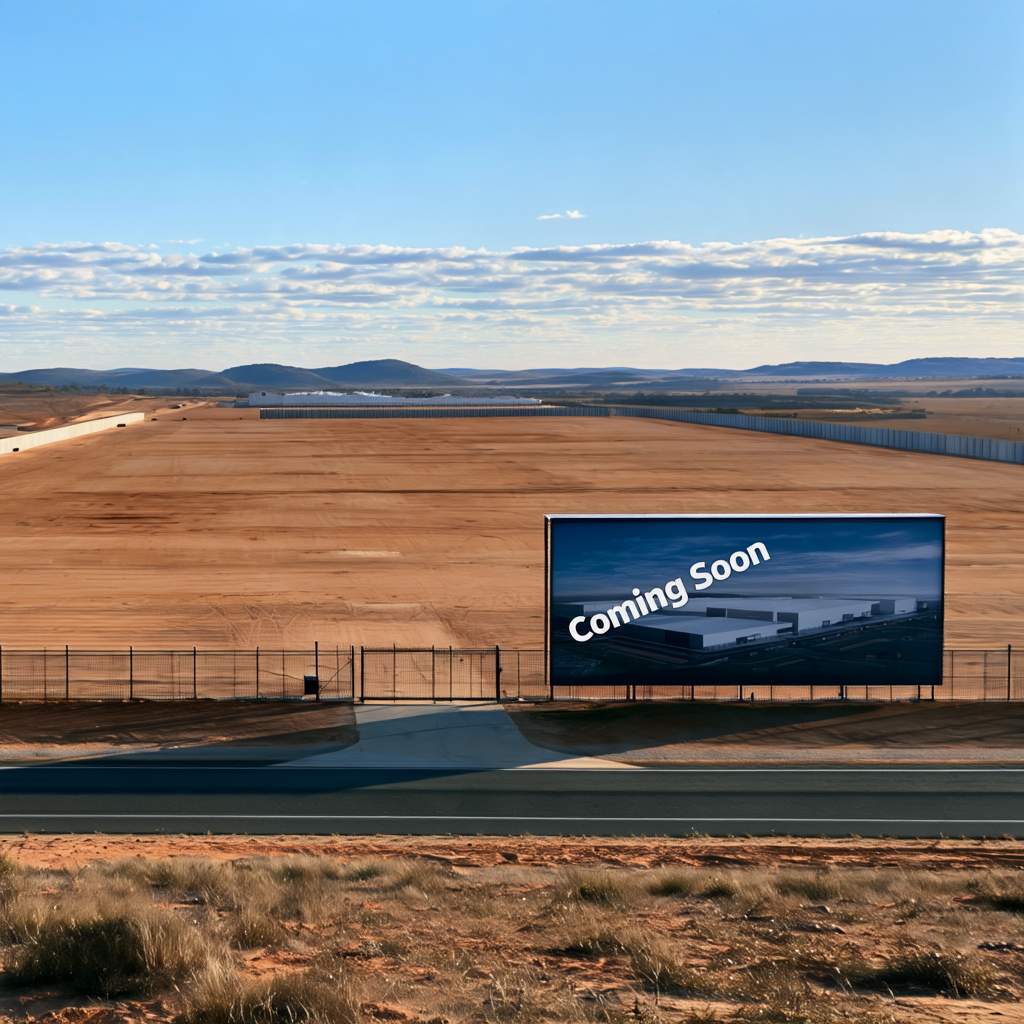
On Monday (26 October 2026), CBA’s economics team published its latest read on Australia’s Data Centre pipeline. The headline is $260 billion of investment by the mid-2030s. That’s the number that will be in every board pack by Christmas.
If I were you I would not look at the number.
The number I would be be looking at is 23 versus 7.
23 is the gigawatts of Data Centre capacity that have been publicly announced in Australia. 7 is what CBA thinks is actually feasible (up from 6GW in their August call). Put simply, CBA’s economists, who are broadly upbeat about this boom, think only about 7 of every 23 announced gigawatts is realistic. That’s roughly 30%. The other 70% won’t get built this cycle.
After more than 25 years in and around Data Centres, including running one as CTO of a UK colocation facility, I’d call that a sensible starting point, not a pessimistic one.
Announced isn’t built
Here’s how CBA (Commonwealth Bank of Australia) breaks the 23GW down. About 3.6GW is under construction or being expanded. Another 2GW has development approval or is in pre-construction. That’s 24% of the announced pipeline. The other 76% is in planning or earlier.
Now I have lost count of the campuses I have seen launched with a render, a hectare count and a megawatt figure that turned out to be the size of the substation the developer hoped to get. A press-release megawatt and a commissioned megawatt are different animals.
AEMO’s (Australian Energy Market Operator) connection data makes the point even more sharply. As of June, 225 projects were asking for almost 67GW of grid connection. That’s nearly three times the announced pipeline. Why? Because the same handful of hyperscale customers are being chased by several developers at once, each lodging their own application. CBA notes that more than a third of connection requests made in the past year were withdrawn, and puts the median chance of a project getting from where it is today to completion at just a 28% chance.
It’s seven people queueing for the same taxi. One gets in. The other six go home. CBA put it neatly: the data “reinforces our scepticism of the gross 23GW pipeline.”
The four things that decide what gets built
- Power. Then power. Then even more power. AEMO estimates Australian Data Centres used about 5TWh in 2025–26, 2.8% of the electricity supplied through the National Electricity Market. It forecasts around 15TWh by 2029–30 and 34TWh by 2035–36. Generation is only part of it. What matters to a project is the connection, the transmission, the substation and a firm date when it will be energised. A site without a credible energisation date is a paddock with planning permission.
- Long-lead kit and the people to install it. CBA expects construction to peak in the 2028 and 2029 financial years. That’s exactly when every transmission, renewables and infrastructure programme in the country will be chasing the same transformers, switchgear, generators, electricians and commissioning engineers. In my experience, programmes rarely slip because of the design. They always slip because a transformer is 18 months late and the one commissioning team you trust is on someone else’s job.
- Social licence. Community opposition to large developments is growing. Big grey sheds, water use, noise and the perception that they eat local power without creating many local jobs. Developers who treat the community as a planning hurdle rather than a stakeholder will find their timelines stretched. This is where the Government needs to step in and allocate dedicated space away from residential areas that is also well fed with reliable utility services.
- Policy and where the AI work lands. CBA’s central case assumes Australia captures around 10% of OpenAI’s and Anthropic’s estimated global compute demand. If Australia becomes a genuine location for frontier model training and large-scale inference, the upside is 9–11GW. But CBA also flags that uncertainty around copyright law could influence whether large-scale training happens here at all. Demand isn’t a given. It has to be won.
Where the $260 billion actually goes
This is the bit that rarely makes the headlines. CBA expects about 70% of construction costs to be specialised IT equipment rather than buildings and structures. Most of that kit is imported, so a large share of the money flows straight offshore. Another Government opportunity, this is a growth area time to onshore and bring to the local economy.
Add to that and the IT gets refreshed every few years. The shell, the power train and the cooling plant are long-life assets. The servers and GPUs are not. So the $260 billion isn’t one great slab of concrete. It’s a smaller construction prize for builders and trades, plus a recurring equipment bill for operators and their customers.
So, how much will actually get built?
Well my view, CBA’s 7GW is about the right order of magnitude. It’s broadly in line with AEMO’s own demand forecasts of 5.5–6.5GW of additional rated capacity by 2036. Where I’d be more cautious is the timing. Programmes are being hit by unexpected delays. Take NextDCs M3 Melbourne facility, likely to be delayed by 12 months because the promised power is delayed due to residential protests preventing larger power poles being built outside their homes.
Expect phasing, not big bangs. A 300MW campus announcement becomes 30–50MW halls, each built when a tenant signs, built to demand. Expect slippage at every energisation milestone. And remember “rated capacity” is not the same as IT load, which is not the same as utilisation.
If you want a number for your own plan, here’s the rule I use:
- Count it if it’s in the ground and energised.
- Weight it if it’s approved, financed and has a firm connection date.
- Treat everything else as optionality, not pipeline.
What I’d do if I were sitting in your chair
If you’re an enterprise or government buyer of capacity: don’t assume today’s market will still be a buyer’s market in 2028. Lock in capacity and power commitments early and test your provider’s energisation dates as hard as you test their price.
If you’re an investor or lender: discount the pipeline by stage, not by headline. Ask for the connection agreement before the render.
If you’re an operator or developer: your competitive advantage over the next three years isn’t land. It’s delivery, grid access, supply chain, commissioning capability and the governance to land phases on time and on budget.
The boom is very real. CBA’s numbers still point to Australia’s Data Centre capacity more than quadrupling to around 9.2GW by the mid-2030s. But the winners won’t be the ones with the biggest announcements. They’ll be the ones who actually get the megawatts energised.
That’s the part of the industry I spend my days in, from Data Centre fit-outs and procurement to helping colocation providers sort out delivery. I’d be keen to hear from others in the trade, what discounts are you applying to the announced pipeline?
Source: CBA Global Economic and Markets Research, “Australia’s data centre pipeline growing to $260bn in a decade”, 27 October 2026.
Summary
CBA’s $260 billion headline hides the real story: of the 23GW of Data Centre capacity announced in Australia, only about 7GW is realistic, so roughly 70% won’t be built this cycle.
Power connections, long-lead equipment and skilled trades, community support and policy will decide what gets built, and the winners will be those who actually get megawatts energised, not those with the biggest announcements.
About the Bushey Data Centre Practice
We have spent our careers inside Data Centres, not just advising on them. Our founder Barry Lewington was CTO of a UK colocation business and has since supported Data Centres of every size as they grow, from single-hall enterprise sites to multi-megawatt colocation campuses. We know first-hand that a Data Centre programme rarely fails on its technical design. It fails on the grid connection date, the planning conditions nobody read, or a key stakeholder nobody spoke to.
The Bushey Data Centre Practice provides independent, client-side support to organisations building, buying or running Data Centre capacity. We help:
- Enterprises and Government Departments procure hosting and colocation, plan fit-outs and migrate safely.
- Colocation and Data Centre operators resolve internal challenges, strengthen governance and deliver expansion programmes on time.
- Organisations going through change merge, separate or consolidate their Data Centre estates as part of M&A activity.
Every engagement is delivered using our proprietary Transformation framework. It brings Project Management, Change Management and Governance together, so power, permits and people are managed as seriously as the build itself. Our focus is always the business benefit: taking complex programmes through to results, not just to plan.
We’re a specialist boutique consultancy based in Australia with reach across APAC. Because we’re independent, we sit on your side of the table, with no products to sell and no vendor to protect.
#DataCentres #AIInfrastructure #EnergyTransition #AustralianEconomy #DigitalInfrastructure

Comments are closed