
If you caught the business pages last Wednesday, just like me, you may have noticed a surprising piece of news. It was not blazoned across the front pages but it is a significant message.
NextDC, Australia’s largest listed Data Centre developer, saw its shares fall around 40% in a single day. It was the company’s worst day of trading since it listed in 2010, and roughly $3 billion of market value disappeared before lunch. Think about that for a minute 40% wiped off the value of the company in one day.
Usually, these situations are caused by a fraud, accounting irregularities or a governance failure, or a catastrophic operational, technology or regulatory event.
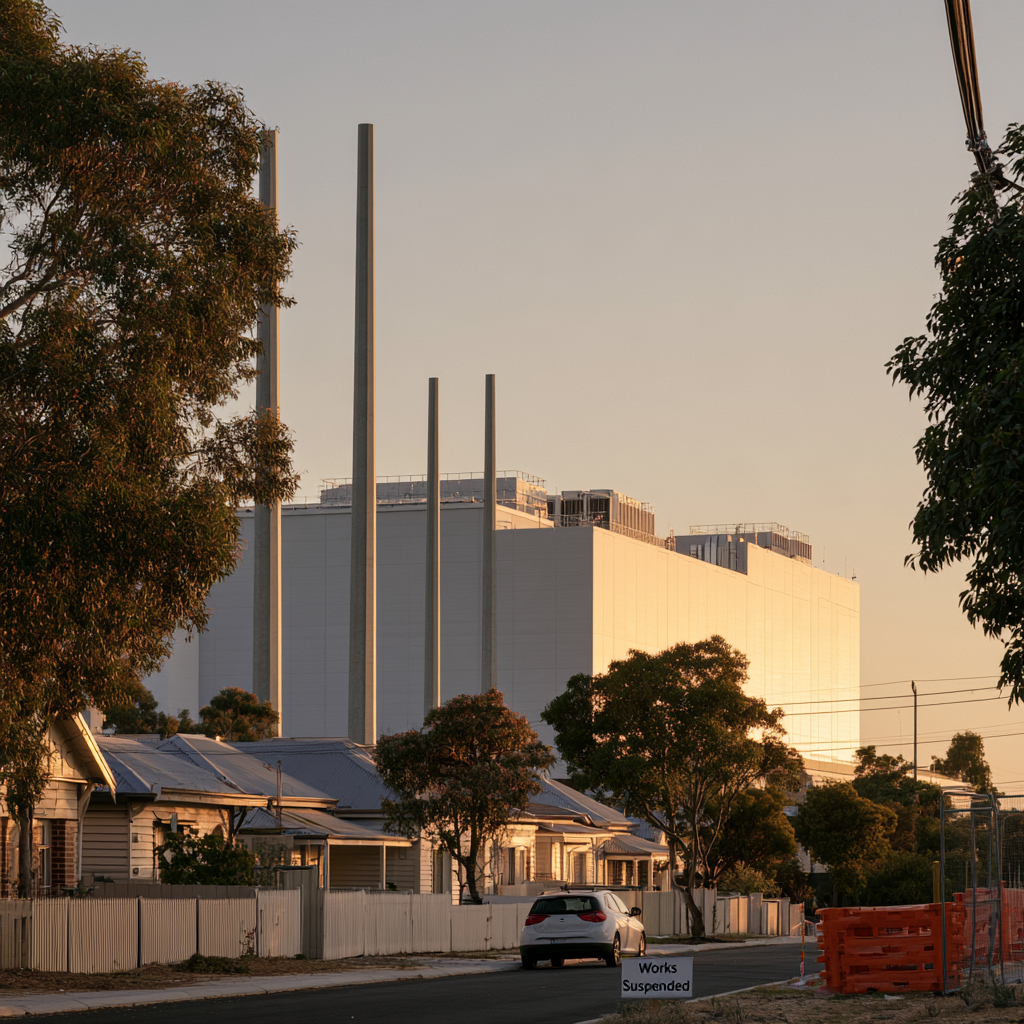
Strangely it was none of these. I know NextDC well, customer demand remains strong in a tough market. The cause was NextDCs new M3 facility in Melbourne’s west. All is going well with the construction of the building, in fact, it is largely built and its contracts are all signed. The problem is the delivery of one of the key components of a Data Centre, POWER.
In September, Jemena (a major Australian energy infrastructure company) suspended work on upgrading the local power network. The plan was to replace the power poles in Yarraville and West Footscray with much larger concrete poles, up to 22 metres high, carrying 66 kilovolt services.
All was going well until the residents objected, the council withheld consent while further consultation takes place, and the work isn’t expected to restart before February 2027, at least a 6 to 12 month delay. As a result, NextDC has since cut its FY27 earnings guidance to the market by more than a third, Ouch!
Now just to be clear, I have a great deal of respect for the team at NextDC, and I want this to be made very clear this isn’t an article about blame. This I hope is a lesson the market and every Data Centre provider must learn from, not just those located in Australia, but globally who are delivering large programmes should sit with for a moment.
Capital is not the constraint
For the last few years, the Data Centre conversation has been about the availability of money for Data Centre builds, we couldn’t build them fast enough, the cost of building a Data Centre has progressively increased as power usage and IT densities increase. New facilities now require billions to be committed on the strength of AI demand. But M3 shows something many of us in this industry have known for a long time, the hardest dependencies no longer sit with the finance team, they are far more basic than that now they are the simple power poles, the permits and the people who are affected by them.
Now this is something I learnt early in my career. When I was CTO of a colocation business in the UK, the technical designs rarely worried me, we had a great team who were working with key market suppliers. The problems were the supplier connection dates. The complexity of upgrading power lines or laying new cables across the centre of London was a nightmare of permits and routing and just when you thought you got the approval it was replanned and pushed out due to an emergency event. Unfortunately, these things don’t sit neatly on a Gantt chart, yet they decide whether your programme lands on time, and your customers are going to get the services we have committed to.
The NextDC issue is not the exception either, Goodman (a major global property group and a leading developer, owner, and manager of large-scale Data Centres) also walked away from a $1.2 billion Sydney Data Centre in September after opposition from residents and policymakers. In the United States, more than a hundred projects have reportedly been blocked or delayed this year. The pattern is hard to ignore.
A stakeholder, not an obstacle
Here’s what strikes me most. The residents of Yarraville and West Footscray aren’t anti-technology, they are people, just like you and me who are objecting to looking at a 22-metre concrete pole outside their front window and asking fair questions. I am sure even Craig Scroggie CEO of NextDC would be the first complain and ask the question Why here? Why this size? What’s in it for us? And why are we only hearing about it now?
In most Transformation Programmes, we would never roll out a major change without a proper change management plan. Yet communities, councils and network operators are often treated as a permitting step, not as people whose support the programme depends on. The lesson isn’t that communities are a problem to be managed. It’s that they are part of the programme.
There is a fundamental lesson at the centre of this. It is unfortunate that NextDC has been the high-profile organisation that highlighted it. Within the Australian market we have an issue that could cost the Australian economy many millions even billions of dollars of international income, because M3 could not be powered up in time to meet customer contracts. The same contracts could be revoked and customer go elsewhere, outside of Australia for their services, a lost opportunity for Australia.
It’s a national issue, not just one company
We now have a national issue, in ensuring we can power up and meet our continued demand for more power to keep supporting this sector. A country with such natural resources and an environment that would lead to increased use of clean green power (both hydro and solar), and I am not going to get into the nuclear discussion, we are struggling to keep pace with the generation and distribution of sufficient power the country needs to continue to grow and be a leader.
The Australian Government must take responsibility for the policies and allocation of investment to provide for building the required critical infrastructure. We have the skills and the expertise. We do need to rethink whether placing these large windowless facilities on the doorstep of residents is right. Forget how much we make them look pretty, they do emit a constant hum and when the generators are started emit diesel exhaust. What is required is the allocation of the right space, away from residential areas, create special Technology Parks where power, water and the required telecoms services are provided to enable the facilities to be built and thrive.
A closing thought
If you’re leading a Data Centre build, a fit-out, or any major programme that depends on someone you don’t control, I’d genuinely love to hear how you’re thinking about this. And if a second, independent pair of eyes on your critical dependencies would help, my door is always open. Just reply and we’ll find a time for a coffee.
Summary
NEXTDC’s 40% share-price fall shows that the Data Centre boom’s real constraint isn’t capital but power poles, permits and people: community opposition stalled a single grid upgrade and wiped a third off its earnings guidance.
The Australian Government needs to drive the investment in critical infrastructure as well as allocating suitable space away from residents so the market is able to thrive and allow Australia to be a leader in the sector.
About the Bushey Data Centre Practice
We have spent our careers inside Data Centres, not just advising on them. Our founder Barry Lewington was CTO of a UK colocation business and has since supported Data Centres of every size as they grow, from single-hall enterprise sites to multi-megawatt colocation campuses. We know first-hand that a Data Centre programme rarely fails on its technical design. It fails on the grid connection date, the planning conditions nobody read, or a key stakeholder nobody spoke to.
The Bushey Data Centre Practice provides independent, client-side support to organisations building, buying or running Data Centre capacity. We help:
- Enterprises and Government Departments procure hosting and colocation, plan fit-outs and migrate safely.
- Colocation and Data Centre operators resolve internal challenges, strengthen governance and deliver expansion programmes on time.
- Organisations going through change merge, separate or consolidate their Data Centre estates as part of M&A activity.
Every engagement is delivered using our proprietary Transformation framework. It brings Project Management, Change Management and Governance together, so power, permits and people are managed as seriously as the build itself. Our focus is always the business benefit: taking complex programmes through to results, not just to plan.
We’re a specialist boutique consultancy based in Australia with reach across APAC. Because we’re independent, we sit on your side of the table, with no products to sell and no vendor to protect.
Comments are closed