As AI becomes part of how decisions get made, the question of who owns those decisions , and how they’re governed, becomes unavoidable.
Book a Discovery Call How We Deliver
From operational choices to strategic insight, AI is now part of how decisions get made. The question is not whether AI is influencing decisions, it is whether those decisions are explainable, owned, and governed.
AI-influenced decisions aren’t a one-time approval. They need oversight that continues for as long as the decision keeps being made, every day the model is in operation, not just on the day it was signed off.
Not about generating outputs. About ensuring the decisions those outputs support are transparent, accountable, and signed off, where they can be explained, not just produced.
AI applied to an undefined decision doesn't clarify it, it accelerates the confusion.
AssureChange™ operates on a Human-In-The-Loop principle — AI supports every decision, but a named person owns it.
An AI-supported decision that cannot be explained is a liability. Regulators, boards, and affected parties will ask how it was made — the answer needs to exist before they ask.
As AI supports more decisions across the organisation, the ability to see where, how, and by whom those decisions are being made becomes critical, and fragile.
AI decision support changes not just what decisions are made, but how people engage with the process of making them. Without structured adoption, the governance exists but the behaviour doesn't follow.
Decision support is embedded into how the organisation operates.
In practice, AssureChange™ ensures every AI-supported decision operates within a structure where it can be defined, owned, explained, and traced.
When a decision support system is defined, owned, and traceable, the organisation can stand behind something a model influenced, not just hope it was right.
AssureChange™ ensures AI Decision Support operates as part of a governed, accountable system, so every decision it supports can be explained, owned, and defended.
On one engagement, a regulator asked a client to explain how an AI-influenced credit decision had been reached eight months earlier. Because the decision had been logged with its model version, inputs, and the named approver at the time, the explanation took an afternoon to produce, not a forensic reconstruction project.
Worth knowing the answer before it’s an incident review instead of a planning conversation about what’s actually ready to scale and what isn’t yet.
AI analytics produces outputs, reports, predictions, and recommendations. AI Decision Support governs what happens next. It ensures the decision those outputs inform is clearly defined, owned by a named individual, explainable to anyone who asks, and connected to a measurable outcome. The difference is not in the technology, it is in the governance structure around it.
The person who would be accountable for the decision without AI support remains accountable with it. AI does not transfer ownership of a decision, it informs it. AssureChange™ ensures that accountability is named before AI support is applied, maintained throughout the process, and visible to the organisation at all times.
Without governance, the answer is usually unclear, which makes the problem harder to fix and the liability harder to manage. With AssureChange™, every AI-supported decision is traceable from the data that informed it through to the outcome it produced. When something goes wrong, the cause can be identified, the owner is already named, and the correction can be applied without a root-cause investigation from scratch.
It is embedded into them, not added as a parallel layer. AssureChange™ integrates decision support into existing delivery and operational processes, ensuring AI insight is applied within the structure your organisation already uses to make decisions. Existing governance frameworks are the starting point, not something to be replaced.
Yes, and they need to be. Regulators are increasingly focused on how AI influences decisions in regulated environments. AssureChange™ ensures every AI-supported decision is explainable in business language, with a documented trail from data source through AI insight to the decision made and the outcome produced. The evidence exists before it is requested.
It means a named person owns every decision that AI supports, they review the insight, apply their judgement, and are accountable for the outcome. AI does not make the decision. It informs the person who does. AssureChange™ enforces this principle across every AI-supported decision in the organisation, regardless of team, seniority, or decision type.
Reliability starts with the data. AssureChange™ ensures the data informing AI insight is validated, governed, and traceable before it enters the decision process. The AI's role within each decision is explicitly defined, what it analyses, what it recommends, and where human judgement takes over. Outputs are presented in business language so decision-makers can interrogate them, not just accept them.
Any decision where AI is being used to analyse data, generate insight, or recommend a course of action, from operational choices to strategic ones. The governance framework applies consistently regardless of decision type. Higher-stakes decisions carry higher-control requirements within AssureChange™, ensuring the governance standard scales with the impact of the decision being made.
AI Decision Support is one component of a connected system. It operates within the same AssureChange™ framework as AI Use Case Delivery, AI Intelligent Automation, and AI Data Foundation, ensuring that decisions, data, automation, and outcomes are all governed consistently. Decision support that operates in isolation from the wider AI programme creates gaps that eventually surface as accountability problems.
It depends on the complexity of your existing decision environment and the maturity of current governance. In most organisations, a structured assessment identifies the gaps within two to three weeks, where decisions are currently being influenced by AI, where ownership is unclear, and where explainability is absent. From there, the governance structure can be embedded into existing processes without stopping the decisions that are already being made.
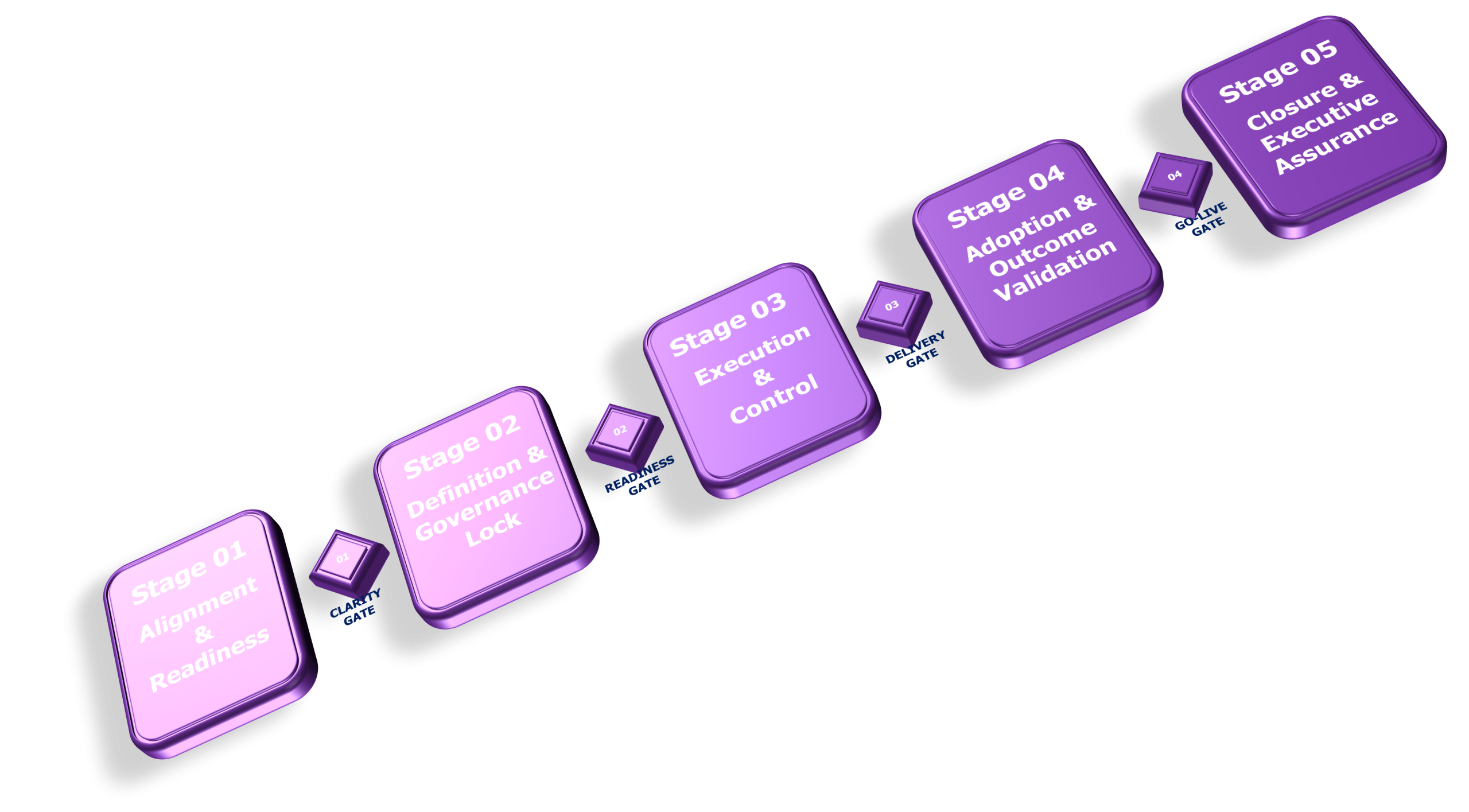
AssureChange™ is Bushey’s delivery and governance control framework used to manage and deliver transformation with clarity, control, and accountability from start to finish.
Unlike traditional frameworks that guide activity, AssureChange™ provides structured control over decisions, risk, and accountability ensuring outcomes hold under real operating conditions. https://busheyit.sharepoint.com/sites/allstaff/_layouts/15/Doc.aspx?sourcedoc={614ED20D-2CA3-4A61-B506-56C20CC54FA6}&file=Assurechange website feedback 20260511.docx&action=default&mobileredirect=true&DefaultItemOpen=1
No. AssureChange™ is not a methodology, toolkit, or standalone service. It is the governance and delivery framework that underpins every Bushey engagement.
AssureChange™ is applied across all transformation contexts including: Technology transformation programmes Data Centre and infrastructure change AI and cyber initiatives M&A technology integration engagements
It introduces: Stage-gated decision control Evidence-based progression Clear accountability ownership Continuous governance visibility This ensures projects move forward with control, rather than assumption.
AssureChange™ governs three core areas: Decisions – made with evidence and clear authority Risk – identified early and actively managed Accountability – defined and owned throughout delivery
No. AssureChange™ is applied consistently across all engagements, ensuring the same standard of governance and control regardless of project type or complexity.
It provides: Clear decision checkpoints Transparent reporting Evidence-based assurance Full visibility of risks and progress This allows leaders to stand confidently behind delivery outcomes.
No. It works across all delivery parties, providing a consistent governance model regardless of who is executing the work.
Organisations can expect: Controlled scope and execution Predictable, measurable outcomes Strong governance and accountability Stable transition into operations This enables transformation to be delivered with certainty, not risk.